HAROUM :
Haroum is a solo exhibition by Elika Hedayat, curated by Valentina Ulisse taking place Drawing Lab in paris from October 17 to January 4, 2026.
"[...] practices of living and dying in rich worldings that I think of as string figure games"
Donna Haraway, Staying with the trouble
In several works of Persian literature written between the 10th and 12th centuries, Haroum is described as a city governed by learned women, who live in equality and peace with the environment. Free and independent, they seem to echo the Amazons, warrior women of Greco-Roman mythology, who became a symbol of female emancipation and gender equality.
In these ancient Persian epics, animals and imaginary creatures occupy a remarkable place and, in constant alliance with humans, help to blur existing boundaries between genders and species. Simorgh, for example, a long-lived bird with invaluable knowledge, is a central, metamorphic character, a creature neither feminine nor masculine.
To give shape to her own vision of Haroum, artist Elika Hedayat wanted to mix references as if in a "game of strings" made of twists and tangles, close to Donna Haraway's "speculative fabulation".
She has drawn as much on the mythical literature of her native Iran as on contemporary feminist and ecological science fiction, while taking as her foundation transdisciplinary scientific theories based on the idea of symbiosis that extends from the living to the technological.
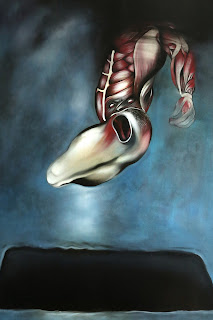
Her fantastical storytelling never forgets the current situation and struggles of Iranian women today. These are constantly evoked by the artist through the use of black hair (living matter), plugs and cables (technological elements).
Slipping through space, these filaments that link and connect organisms and territories free themselves from constrictions and powers. They are cyborgs, presences-guides in the narrative. Their intervention is discreet but rhizomic: they are at the heart of the feminist and symbiotic cultural evolution of Haroum, which Elika Hedayat envisions as a city of the future.
The exhibition designed for the Drawing Lab is intended as a discovery of this world still under construction. In the artist's works, Haroum appears as a city-laboratory, in its embryonic state or at the model stage. Inspired by the work of Vinciane Despret and the animal ingenuity observed in therarchitecture, these elevations reveal an art of construction that is no longer solely human, but inter-species.
His habitant-x, mysterious, tentacular creatures, appear as much on wall drawings as in immersive, even "abyssal" installations. Here, the artist combines animated video with the tradition of Pardeh Kahni (curtain storytelling) - an ancient form of storytelling in Iran, where the storyteller reads and narrates epics depicted on painted canvases.
The archive format is also activated and made dynamic: the artist gives his own interpretation of history, fiction and science. Arborescent thoughts, in which forms of expression extend beyond human literary categories, constitute a collection of chronicles, materials, characters and voices at the origin of this contemporary interpretation of Haroum.
Using a variety of artistic techniques and experiments, Elika Hedayat interprets drawing in multiple forms, demonstrating the different ways in which it can be "set in motion".
Through a lineage of metamorphoses, the line of a sketch becomes the line of a digital model and finally the dynamic filament of a 3D print.
Through a process of hybridization, every form - subject and landscape - is constantly caught up in a to-and-fro of reciprocal conversions.
Through an interplay of translations, the writing transforms into an image, and then into an oral narrative.
Valentina Ulisse
Exhibition curator




Comments